
Find Woodland Residents in Order
A Woodland residents directory search works best as a short chain of official clues. An owner name in the Yolo Assessor roll is not the same thing as a household list, and a court party is not proof of current residence. Start with the narrowest record that matches the question. An address points toward a parcel, an APN and a deed. A name points toward a court party, license, business filing, or historical directory entry. A family-history question often belongs in the Archives rather than a current lookup.
Each result needs a second anchor. Match a full name with a middle initial, spouse, occupation, parcel, legal description, date, or known geography before treating two records as one person. The public trail can miss unlisted household members, unregistered voters, children, protected participants, and people whose mailing address differs from the place they occupy. It can also retain stale entries. A resident directory is therefore a set of record populations, not a promise that every person in Woodland appears.
- Roll
- An organized list held by an office, such as an assessor list of parcels, assessee names, values, and exemptions.
- Index
- A name or party pointer to a recorded instrument; it is not the deed image or complete file.
- Criss-cross directory
- The street-order half of a printed directory, used to move from a number to a listed name.
- Parcel
- A mapped unit of land identified by an APN, legal description, or subdivision reference.
- Check the Yolo Assessor roll by a known parcel or address, then save the APN, assessee name, mailing address, latest document, and exemption field.
- Use California My Voter Status only for the person’s own authenticated record. A public, name-only voter search is not available.
- Search the Yolo official-records index for deeds, liens, easements, and related instruments, remembering that images are viewed at the office kiosk or ordered.
- For an older household, use the Yolo Archives Polk and miscellaneous directories, newspapers, yearbooks, maps, and family collections.
- When a record is not online, ask the custodian for an existing record or use a California Public Records Act request where that law applies.
Note: The first search should answer a defined question, such as ownership, a past address, a court event, or a family connection.
Woodland's Records Counters
Woodland is Yolo County’s seat, so a compact records route links three important counters. The Yolo County Clerk-Recorder at 625 Court Street handles recorded real-property documents and vital copies. The Assessor and Tax Collector counter at the same Erwin Meier Administration Building supplies the local roll and map books. Yolo Superior Court is at 1000 Main Street, while the Yolo County Archives at 226 Buckeye Street holds the older bridge between names, parcels, families, and buildings. These offices answer different questions, even when the same person appears in each.
Yolo County Elections
625 Court Street
Woodland, CA 95695
See current county contact
Woodland Assessor Roll Clues
The Yolo Assessor is the best first stop when an address is known. The public description places the local tax roll and map books at the counter, rather than promising an unrestricted owner-name web database. A staff call at 530-666-8135 can cover up to three parcels. At the public computer, capture the assessor parcel number, location, assessee name, mailing address, land and improvement values, homeowner exemption, latest recorded document, and local revenue district.
The distinction between situs and mailing address matters. Situs is where the parcel sits. Mailing address is where assessment correspondence goes. A matching mailing and situs address can be a clue toward owner occupancy, but it does not list every person in a household. A different mailing address can indicate an owner elsewhere, a trust, or a management arrangement. Property characteristics such as year built and square footage are separate products for most residential parcels.
The county’s Assessor access page is the starting point for the roll fields and counter rules. The public front computer is free. The July 1, 2025 fee schedule lists $5 for the first appraisal-record page, $0.25 for added pages, $4 for emailed documentation, $4 for an emailed parcel map, $5 for a printed map, $6.75 per parcel for property characteristics, $90 for a radius search, and $123 per hour for specialized record research billed in 15-minute increments.
The screenshot from the county’s access page is linked to its official source before the image so the roll’s stated fields can be checked against the live office instructions.
View Yolo Assessor access details
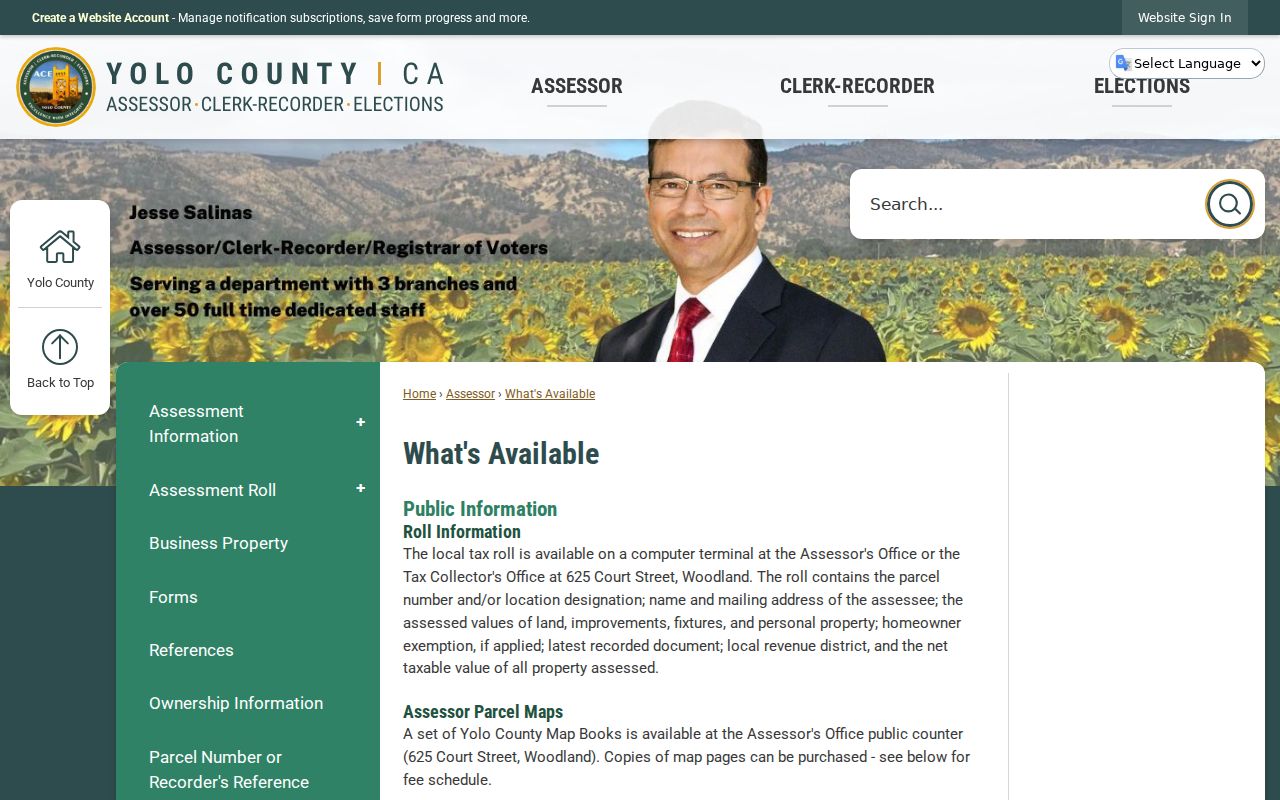
The image supports a careful Woodland residents directory workflow: identify the parcel and latest document first, then move to the recorder or GIS rather than treating the roll as a household register.
Note: A phone lookup is limited to three parcels, so prepare exact addresses or APNs before calling the Assessor.
Woodland Deeds as Bridges
The Yolo County Clerk-Recorder indexes deeds, deeds of trust, reconveyances, liens, releases, easements, notices, and other recordable instruments. Office records are available from 1850 onward, but the county does not state the earliest date of the web index. That wording matters. It is safe to say the office has an 1850-to-present record spine, not that every 1850 document can be opened online.
The web index is a human, interactive search tool. The county says automated or robotic collection is prohibited and staff do not perform title searches. Search a grantor or grantee, compare the recording date, select the relevant document, and order a plain or certified copy if needed. Document images are not exposed as a general public web gallery. They are viewed at the office kiosk or obtained through the county’s copy process. The Copies & Searches instructions explain the access split.
- Indexed party: Grantor, grantee, borrower, lender, lien claimant, or another named role.
- Document type: Deed, deed of trust, reconveyance, lien, easement, release, or notice.
- Date and number: Recording date plus the document or instrument reference; book and page may appear.
- Property pointer: Legal description, parcel reference, subdivision, or other land description.
- Image route: Office kiosk or purchased copy, not an unattended web-image feed.
A deed can connect a person to a transfer, but a deed of trust is financing and not an occupant list. A quitclaim transfers whatever interest the signer held without guaranteeing full title. Match the APN or legal description because a reused street number can send a search down the wrong path. For recording questions, the Clerk-Recorder lists 530-666-8130 and a mail address of P.O. Box 1130, Woodland, CA 95695. The Yolo recording page gives the office’s recording methods and processing information.
The official-record screenshot below belongs to the Yolo search source. It is useful as a visual cue for the index-to-copy distinction, not as a substitute for a current search.
Open the Yolo Official Records Search
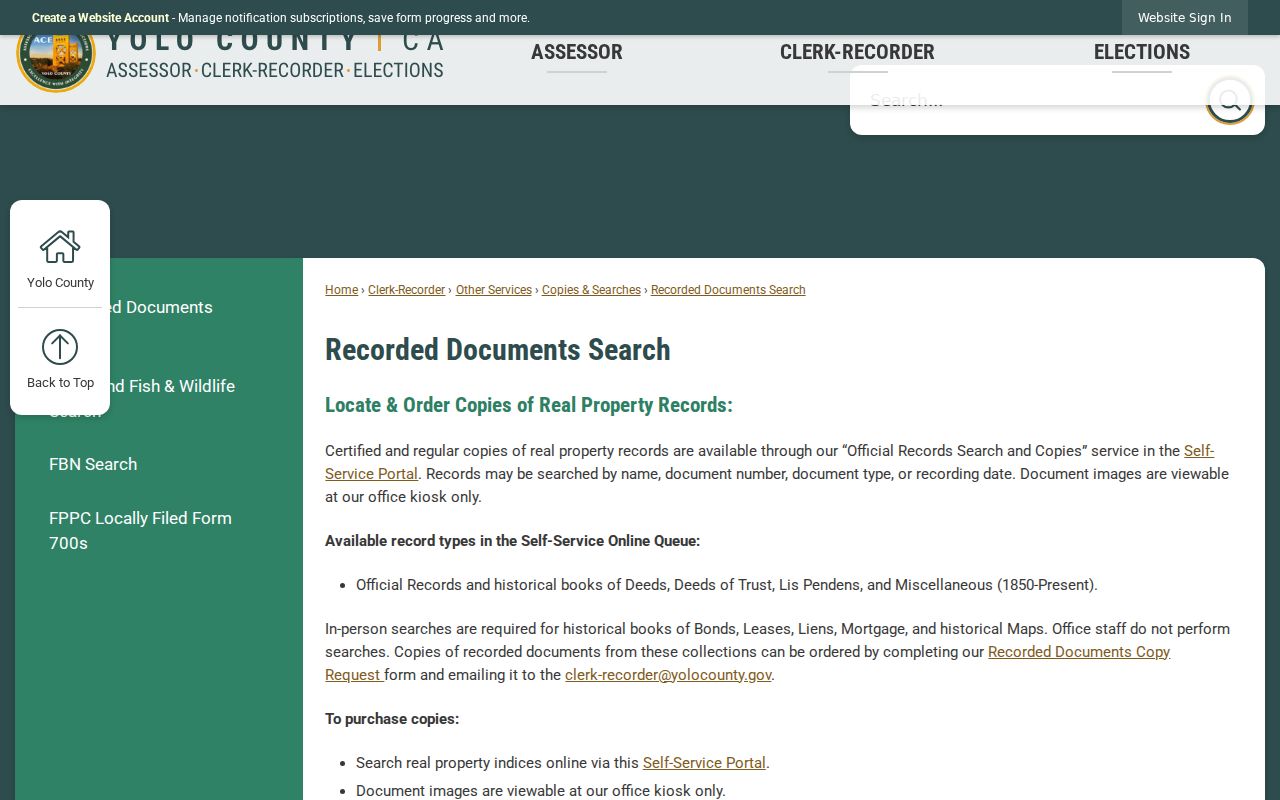
That record trail lets a Woodland residents directory search move from an assessed parcel to named parties without claiming that any one document proves present residence.
Woodland Court Name Searches
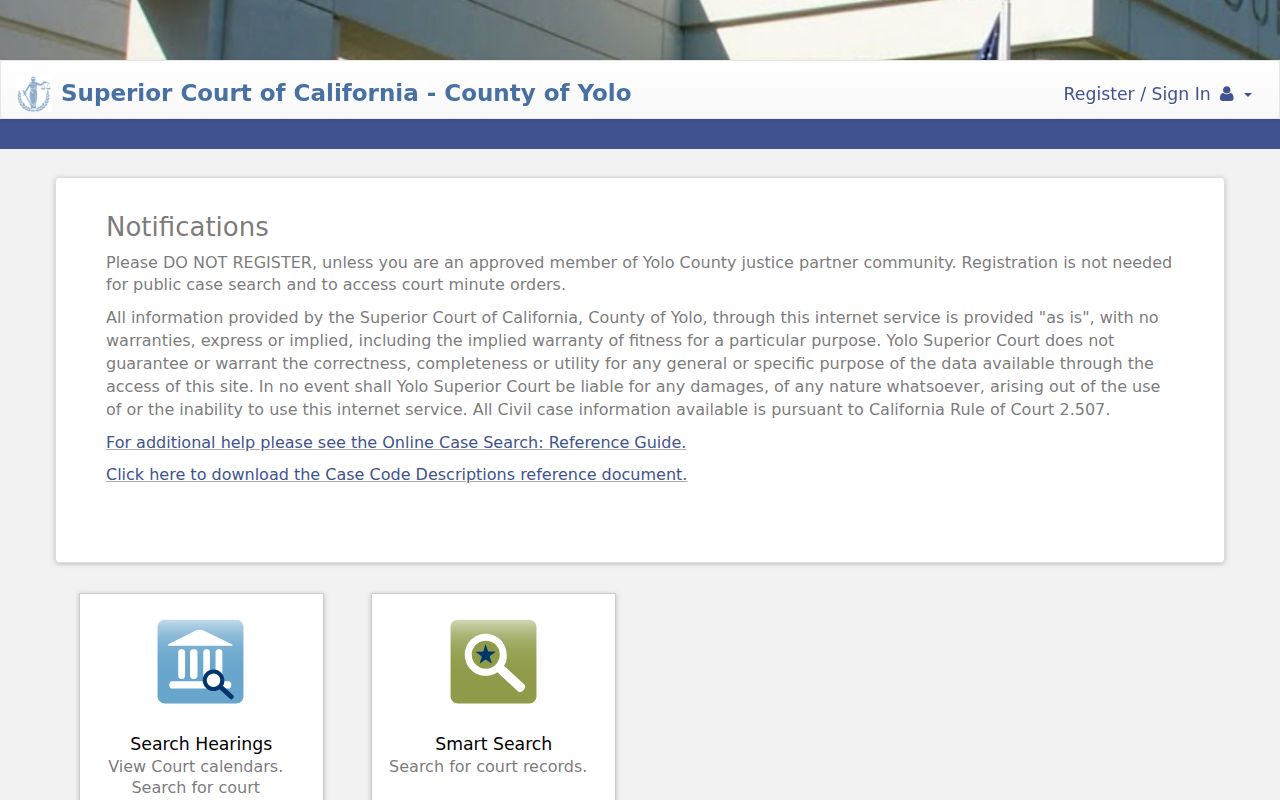
Yolo Superior Court at 1000 Main Street is Woodland’s trial-court channel. There is no separate municipal court for the local mix of civil, criminal, family, probate, small-claims, and traffic matters. The Yolo Tyler public portal provides summaries for many case types and upcoming hearings, while the clerk holds the full public file. Remote visibility is narrower than courthouse access, and a confidential filing does not become public merely because a case number appears.
The official portal guide records the actual search modes. A case-number search can retrieve a known case. A party-name search accepts a person or business. Hearing searches use party, attorney, judge, or courtroom fields, with dropdown requirements in that mode. Results can open a case number and show a caption, party roles, case type, filing date or status, hearing entries, docket events, and linked minute orders or hearing documents when available.
| Search field | Use | What to record |
|---|---|---|
| Case Number | Direct retrieval | Case detail and linked events |
| Party Name | Person or business name | Caption, role, case type, filing date |
| Attorney | Name or Bar number | Related cases or hearing results |
| Judge / Courtroom | Hearing filters | Calendar context and department |
A complaint states allegations, not a finding. A minute order is not automatically a judgment. Probate petitions may name a decedent, petitioner, and proposed heirs, while addresses and inventories can be restricted. For civil copies, the court directs a counter or written request with a case number, party names, document request, payment cap, and self-addressed stamped envelope. The civil line is 530-406-6704. Criminal copies use 530-406-6705; the research notes $0.50 per page, $40 per certified packet, and $15 for a written search with added identifiers. Older public files may be offsite for up to two weeks or destroyed under Government Code §68152 retention schedules.
The court portal screenshot is linked to the same official entry point. It shows the public-search channel, while the clerk remains the source for a complete nonconfidential file.
See the Yolo Superior Court public portal
For federal cases, use PACER for the Eastern District of California. A federal docket can add a party or filing clue, but it belongs to a different court system and its current access fees should be checked before ordering.
Woodland Voter Status Limits
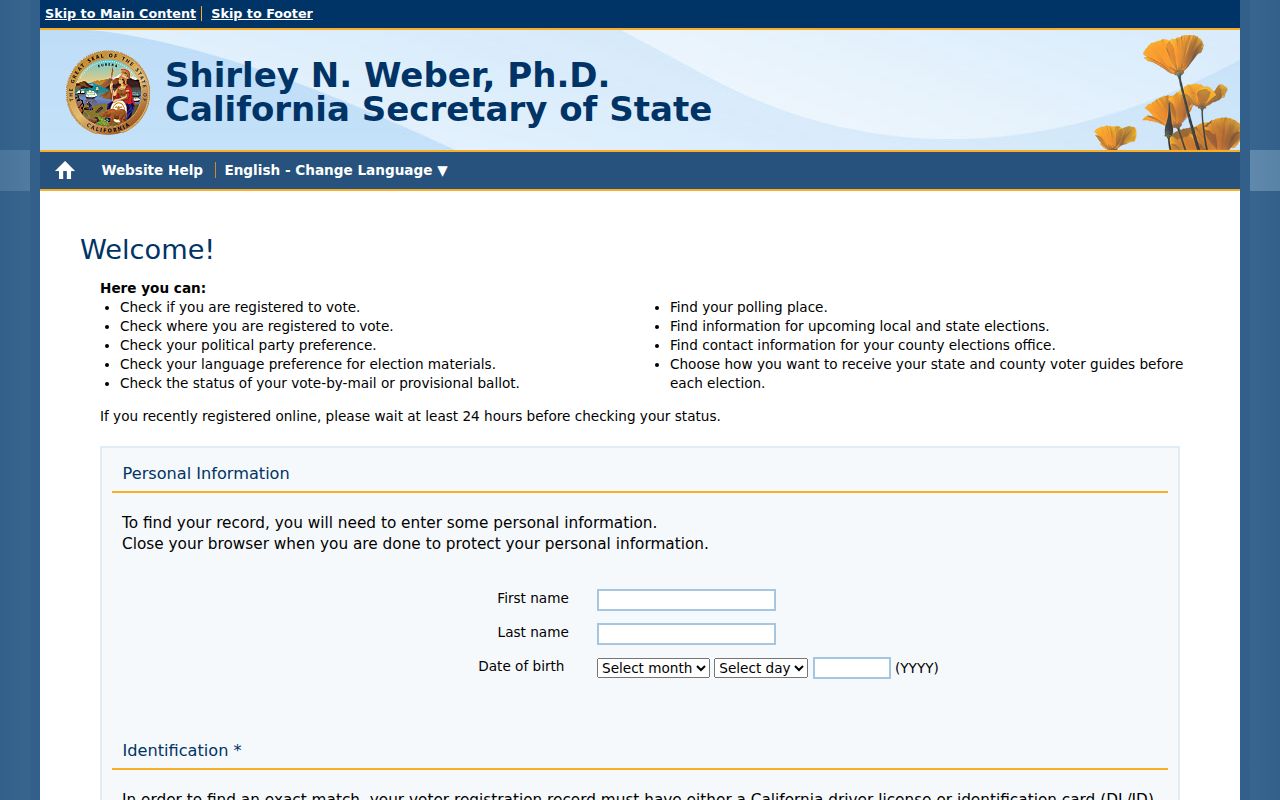
California’s My Voter Status is an authenticated self-lookup, not a public Woodland resident directory. It asks for first and last name, date of birth, and either a California driver license or ID number, the last four Social Security digits, or the available “I do not have” alternatives. A successful match can show registration status and address, party preference, language preference, vote-by-mail or provisional status, polling place, election information, and county contact details.
The tool is designed for the voter checking their own record. California Elections Code §§2188 and 2194 and the related regulations limit voter-data access. A qualified request for a county file must state the permitted purpose, identify the requester, accept the security and use restrictions, and use the county’s form. A street-sorted Walking List can show registered voters by precinct, street, and house number for an approved use, but it does not show children, unregistered residents, noncitizens, or every occupant. Driver-license numbers, Social Security numbers, signatures, and protected Safe at Home voters are not released.
The voter-status screenshot is paired with its official authentication page. It demonstrates why a Woodland residents directory search should not invite a name-only voter search or imply that a neighbor’s registration can be browsed casually.
Verify a personal California voter record
Participation history can identify an election, date, or voting method, never a ballot choice. A public-records request under the CPRA cannot override the voter-file purpose rules.
Current Woodland Resident Sources
No current Woodland residents directory is complete by itself. The most useful sources are narrow rolls with a stated keeper and a stated access limit. The assessor roll is strongest for assessed ownership and mailing information. The recorder index is strongest for parties to recorded instruments. Court dockets, licenses, business filings, and unclaimed-property records show a person’s relationship to an event or organization, not a guaranteed home address. The table separates those uses so a clue is not mistaken for proof.
| Source | Who It Lists | Keeper | Access |
|---|---|---|---|
| Yolo Assessor roll | Assessee, mailing address, parcel and value clues | Yolo Assessor | Counter or phone |
| My Voter Status | The authenticated voter’s own status and election details | California Secretary of State | Self-lookup only |
| Yolo recorder index | Parties to deeds, liens, easements, and notices | Clerk-Recorder | Free index; copies ordered |
| Yolo court portal | Case party, type, filing status, hearings, and docket events | Superior Court | Remote summary; file limits |
| DCA and business searches | License or company affiliation | California agencies | Free summary tools |
Use the Woodland resident lookup when the task is one person and the key issue is identity. Use the street or address pages when the key is a parcel. For a public-records request, name the existing record, date range, address, APN, case number, or document number. A custodian is not required to create a new list simply because a question is phrased as “who lives here.”
Woodland Vital Record Boundaries
Birth, death, and public-marriage copies for Woodland usually begin with the Yolo County Clerk-Recorder, with California Department of Public Health Vital Records as the statewide fallback. There is no local open name index documented in the research. California distinguishes an authorized certified copy from an informational certified copy. An authorized birth, death, or marriage copy requires a qualifying relationship and a notarized sworn statement under Health & Safety Code §§103525–103526. An informational copy is generally easier to request but is marked unusable to establish identity.
For 2026, the state fee table lists $31 for a birth copy, $26 for a death copy, $19 for a marriage copy, and $18 for a divorce certificate of record. Confidential marriages remain limited under Family Code §509. Adoption records are sealed under Health & Safety Code §102705, so a family-history question must use the official adoption-information or mutual-consent route rather than a public-record shortcut. A failed state search keeps the fee and produces a Certificate of No Public Record under Health & Safety Code §103650.
California did not create a simple rule that all births open after 100 years or all deaths after 50 years. Historical indexes, newspapers, church records, cemetery evidence, and Archives collections can supply clues, but a clue is not a certified identity document. The CDPH Vital Records page and its authorized versus informational copy explanation should be checked before any application.
Woodland Classmate Trail
A former-classmate search is one of the more useful personal uses of the Woodland residents directory because it starts with a known cohort rather than an unbounded name. The Yolo County Archives holds Woodland High School yearbooks from 1907 through 1997, along with Woodland Daily Democrat microfilm from 1878 through 1950 and The Mail of Woodland from 1890 through 1952. Yearbooks can supply a maiden name, club, team, faculty role, or graduation context. Newspapers can then test an address, marriage, obituary, business, or civic event.
Use the yearbook for an anchor, not a final conclusion. Record the exact printed name, class year, photograph caption, and any address or family clue. Search the newspaper by spelling variants, spouse pair, and later city. A Spanish-language or compound surname may be indexed in more than one form. Search accents both ways, but do not infer identity from a surname alone. Obituaries and probate can close a historical gap, while a current address requires confirmation from the proper custodian.
The Yolo County Archives collection page explains the appointment-based research setting. The archive was founded in 1985 and brings government records and donated family or business collections into one research room. That co-location is the local story: a school clue, a newspaper notice, an assessment map, and a directory entry may be checked in one visit.
The archive screenshot is linked to the collection page before the image. It represents the historical shelf behind a Woodland residents directory search, not a claim that every volume or newspaper is digitized.
Browse Yolo County Archives resources
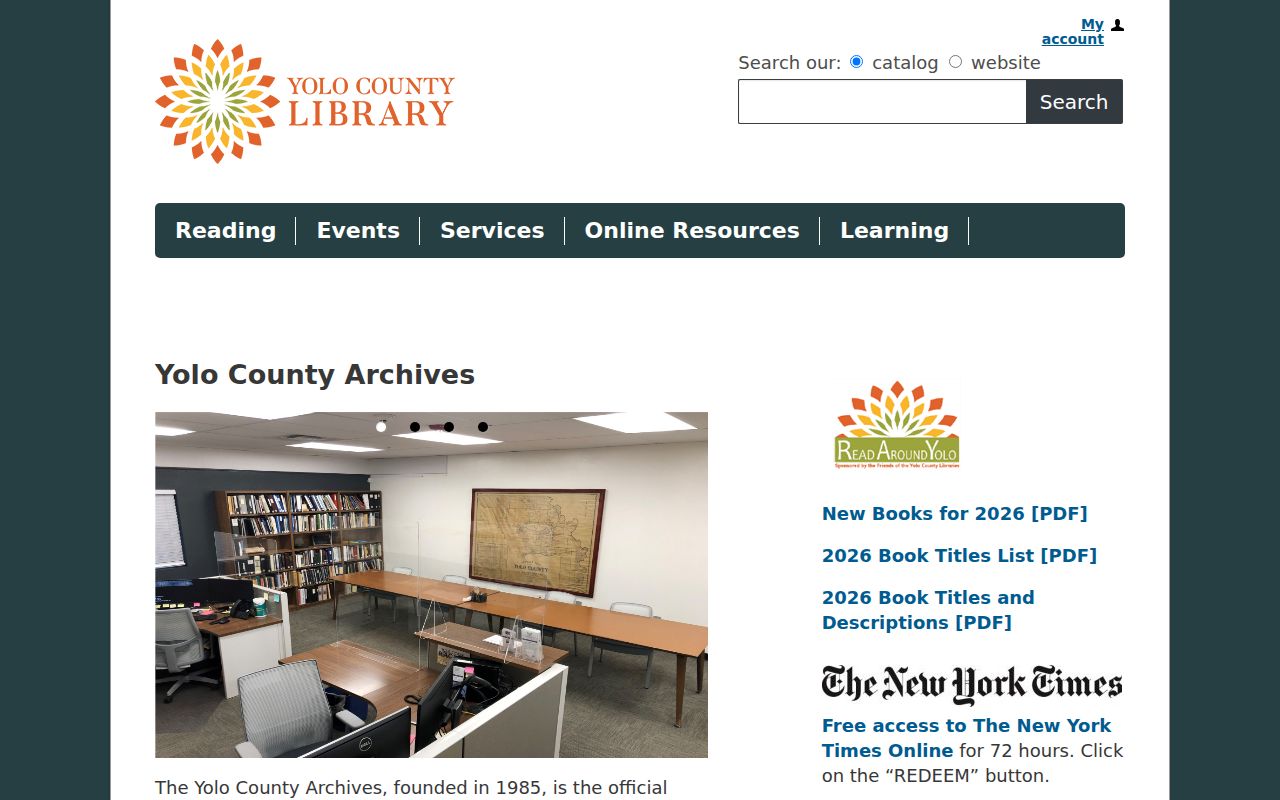
The Archives address is 226 Buckeye Street, with 530-666-8010 and archives@yolocounty.org listed in the research. Appointment hours are Tuesday 9–1 or Thursday noon–4. Bring a research question and cite the exact title, year, page, and collection.
Woodland ZIP Geography
Woodland has two standard ZIP codes in the official sources: 95695 and 95776. The city’s street and ZIP list is more precise than a neighborhood label because it assigns ranges rather than assuming an entire road uses one code. Historic core and west-central examples such as Main Street 1–1199 and Lincoln Avenue 1–1199 fall in 95695. East and southeast growth, including Liberty Drive 2000–2799 and many Spring Lake ranges, commonly uses 95776.
A ZIP is a postal route, not a city limit, tax district, voting precinct, or neighborhood. Some 95695 delivery geography reaches outside the municipality, including Plainfield and rural areas. The list also marks some Spring Lake streets with ranges still to be determined. Verify a complete deliverable address through USPS ZIP Code Lookup, then use GIS and the parcel’s situs address to select the correct city or county custodian.
That geography changes the historical search strategy. Older 95695 addresses are more likely to line up with early Polk, Sanborn, newspaper, and assessment sources. Newer 95776 subdivisions may begin with plats, permits, GIS layers, and recent recorder documents. Neither inference proves who lived at an address. It only tells a researcher which record era and office deserve the first look.
Woodland Protected Records
Some absences in a Woodland residents directory are intentional. California Safe at Home gives qualifying survivors and other protected people a substitute mailing address, confidential mail forwarding, and a confidential voter-registration process. Adoption records are sealed. Juvenile, family, sealed, and protected court materials can remain outside a public case view. Vital-copy eligibility controls access even when an event is known to have occurred.
California’s privacy framework also separates government records from commercial data. Civil Code §1798.100 et seq. gives covered-business consumers rights to know, delete, correct, opt out of sale or sharing, and limit sensitive-data use, subject to exceptions. The DELETE Act created a data-broker deletion mechanism, but those rights do not erase a lawful deed index or change a custodian’s statutory retention duties. DMV information is restricted by the federal Driver’s Privacy Protection Act, 18 USC §§2721–2725.
When a public source is wrong, correct it with the office that holds it. A downstream compilation does not control the deed, court file, voter record, or certificate. Do not try to work around an address-confidentiality program or sealed record. A protected absence should never be read as proof that someone is absent from Woodland.
Lawful use. Woodland records are available for lawful personal research, family history, civic understanding, and consumer caution. Using a record to stalk, harass, threaten, or harm a person can violate California law and is prohibited.
Woodland Official Search Trails
Not every official name search describes residence. The Yolo County Sheriff in-custody search covers the county jail channel, while California’s CIRIS uses a CDCR number or name for published state-custody information. The Megan’s Law registry offers name and geographic modes with statutory display limits and anti-harassment warnings. These tools report only the category of information the agency publishes. They are not a complete Woodland roll and do not establish a current home for every result.
Business filings, professional licenses, and unclaimed property can add a useful affiliation clue. The Secretary of State’s bizfile Online search commonly supplies an entity name or number, status, formation date, jurisdiction, address, agent, and filing history. The Department of Consumer Affairs search can accept board, license type, license number, business, personal name, and city or county fields where offered. The State Controller’s unclaimed-property search shows a reported owner, holder, property type, and old reported address or city. Treat a business, license, or reported address as an occupational or historical connection, not a residence conclusion.
The offender-registry screenshot is linked to its official California source. It is included to show the difference between an official lookup category and a general resident directory.
For a less sensitive affiliation clue, compare DCA License Search or California Unclaimed Property with a separate local record and date. Never merge a same-name result without two independent anchors.
Woodland Lookup Cost Choices
Free access and paid access answer different needs in Yolo County. The front computer at the Assessor is free, while a parcel map, property-characteristics product, radius search, or specialized research carries the fee shown in the county’s schedule. The Clerk-Recorder’s general index is free to search, but images and certified copies are ordered. The court portal gives remote summaries, while a clerk copy, certification, mail search, or offsite retrieval can add a charge. A request should start with the least costly official channel that can answer the question.
| Channel | Lower-cost starting point | Paid route or added product |
|---|---|---|
| Yolo Assessor | Public front computer or a call about up to three parcels | Appraisal pages, parcel map, characteristics, radius search, or specialized research |
| Clerk-Recorder | Free general index search | Office kiosk, plain copy, or certified copy |
| Superior Court | Remote Tyler portal summary | Clerk copy, certified packet, written search, or offsite retrieval |
| Yolo Archives | Appointment and collection question | Confirm any research or reproduction charge before copying |
The free-to-paid sequence is straightforward. Use the Assessor’s front computer first, or call about up to three parcels. Use GIS for a visual block view. Search the recorder index free, then pay only for the kiosk or copy route needed. Use the Yolo Tyler portal for a remote court summary, and ask the clerk about copy or offsite costs. For a historical household, book the Archives appointment and ask about research or reproduction charges before copying.
Commercial people-finder tools may combine stale public and private data, merge same-name people, and charge for records that are free at the custodian. They are not a reason to bypass a restricted voter, vital, court, or confidentiality channel. Confirm a record with Yolo County, the City of Woodland, the court, the state agency, or the Archives before relying on it.
Historical Woodland Resident Directories
Historical Woodland residents directory work begins with the Yolo County Archives Polk finding aid. It identifies 39 books and lists exact Woodland years from 1939 through 1989, including 1939, 1948, 1951, 1953, 1955–1957, 1959–1960, 1962–1963, 1965–1972, 1974–1982, and 1985–1989. A broader Archives brochure describes Polk Woodland directories through 1999 and miscellaneous Woodland directories from 1898–1975, both with gaps. The difference should be preserved: ask staff which physical volume matches the catalog entry.
The Archives also holds yearbooks, newspaper microfilm, Sanborn maps, assessor rolls and maps, deeds, official records, Chamber scrapbooks, Planning Commission records, photographs, maps, and family or business collections. A city directory entry may provide a name, spouse, occupation, and address. A criss-cross section may reverse the lookup by street and house number. Pair those clues with the 1940 or 1950 census, deed chain, obituary, or permit chronology rather than treating a blank year as proof that no one lived there.
The full year-by-year collection treatment belongs in the Woodland city directory collections. The key point for the main residents directory is the bridge from current rolls to the historical shelf: Woodland’s record spine starts around county formation, but much of the most useful household evidence still requires an Archives appointment or an on-site reader.