
Woodland Sources for Past Residents
Previous residents of a Woodland address appear in different source populations across time. The recorder can establish named parties to instruments. Polk and miscellaneous directories can show listed adults or street occupants. The census can show household relationships for public years. Sanborn maps show the built setting. Permits date work. Archives tax rolls and newspapers can bridge gaps. The table keeps ownership, occupancy, household, and building evidence separate.
| Source | Years It Covers | Where Held | What It Shows |
|---|---|---|---|
| Yolo official records | Office records from 1850 onward; web start unstated | Clerk-Recorder | Grantors, grantees, instruments, legal references |
| Polk directories | Exact listed Woodland years 1939–1989; brochure says through 1999 | Yolo Archives | Names, addresses, occupations, street entries when present |
| Miscellaneous directories | 1898–1975, with gaps | Yolo Archives | Earlier name, business, and address clues |
| Federal census | 1850–1950 public under 72-year rule | NARA and library databases | Household relationships and address geography |
| Sanborn maps and permits | Sanborn 1926–1961; permit coverage unstated | Archives / LOC / City | Building footprint, work chronology, project parties |
Start with the recorder and Assessor for a recent owner trail. Start with Polk, census, newspapers, and Sanborn for a mid-century household. Start with Archives maps, tax rolls, deed books, and local collections for a nineteenth-century address. The Yolo Archives at 226 Buckeye Street is the fallback when the web index stops helping.
Start With Woodland's APN
The first step in finding previous residents is to freeze the modern address in a stable form. Use the Assessor roll, map books, or city and county GIS to capture the situs address, APN, legal description, lot or block, subdivision, and latest recorded document. The Yolo Assessor’s public computer is free, and the county lists a telephone service for up to three parcels. A matching mailing and situs address can suggest owner occupancy, but it never proves the household. A different mailing address may indicate an owner elsewhere or a trust.
Keep current and historical APNs in the same worksheet. Parcel splits and mergers can interrupt a backward search. A later APN may not match a deed’s older description even when the land is continuous. Map the parcel, then read the legal description before deciding that a name or address has disappeared.
Woodland Recorder Access Points
The Yolo Clerk-Recorder is the ownership source behind a previous-resident search. Its office records run from 1850 onward, while its public web instructions do not state the earliest date in the interactive index. The web index is free for human searching, and the county forbids automated or robotic collection. Staff do not conduct title searches. Use the counter, phone, mail, kiosk, and copy-order channels instead of assuming the web page contains every image.
The recording screenshot below is linked to the county’s recording information. It is followed by a plain-language reminder that the latest recorded document is a bridge to the deed chain, not a household roll.
Review Yolo recording information
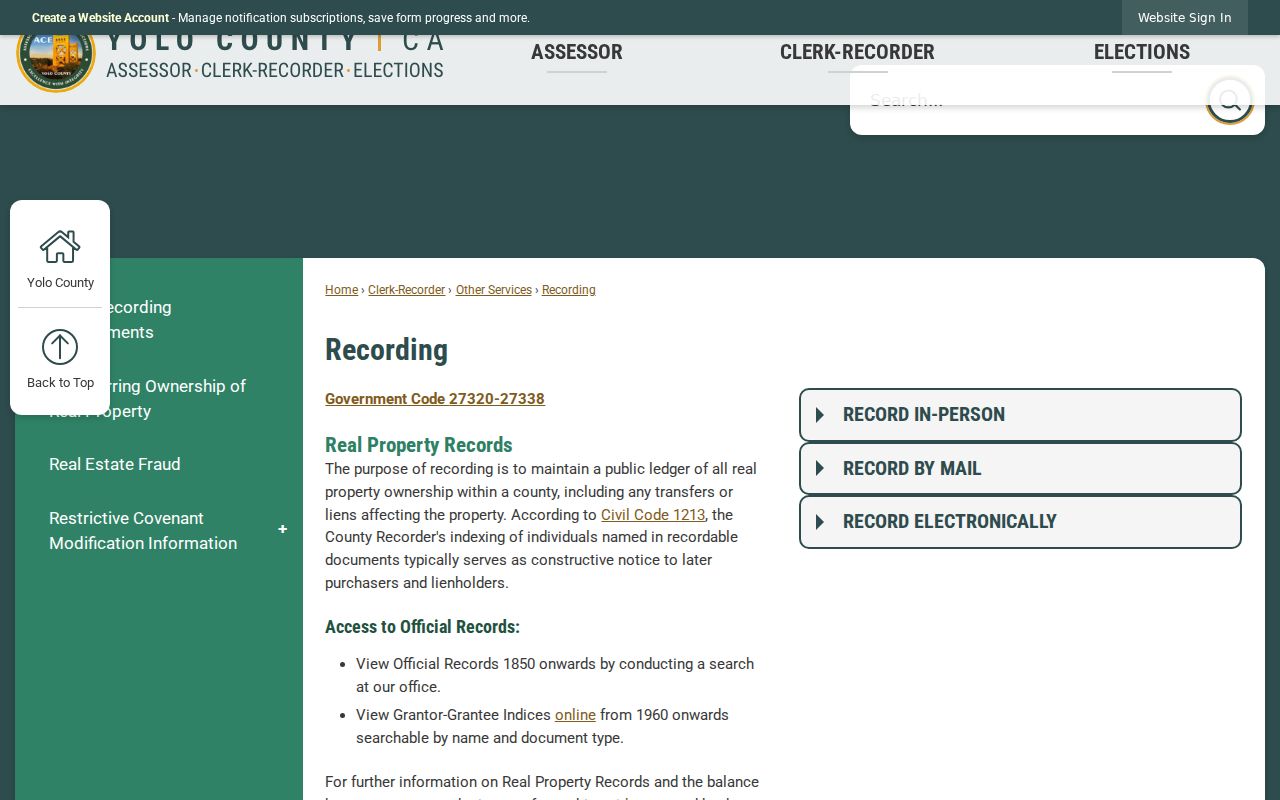
For questions about orders, the research lists 530-666-8130. Mail recording uses Yolo County Clerk-Recorder, P.O. Box 1130, Woodland, CA 95695. The county describes mailed recording in 1–3 business days and eligible electronic returns within two hours, but those are processing channels rather than historical image coverage.
Woodland Deed Copy Routes
An index entry is a pointer. To inspect the instrument, use the Clerk-Recorder kiosk or order a plain or certified copy through the county. The copy type matters when a prior-resident project needs the legal description, transfer language, signatures, or an instrument number that the index summary does not reveal. Sensitive numbers may be truncated or redacted under California law.
The Yolo copies and searches page is the official source for the access distinction. Its screenshot is linked before the image so a researcher can follow the current ordering route.
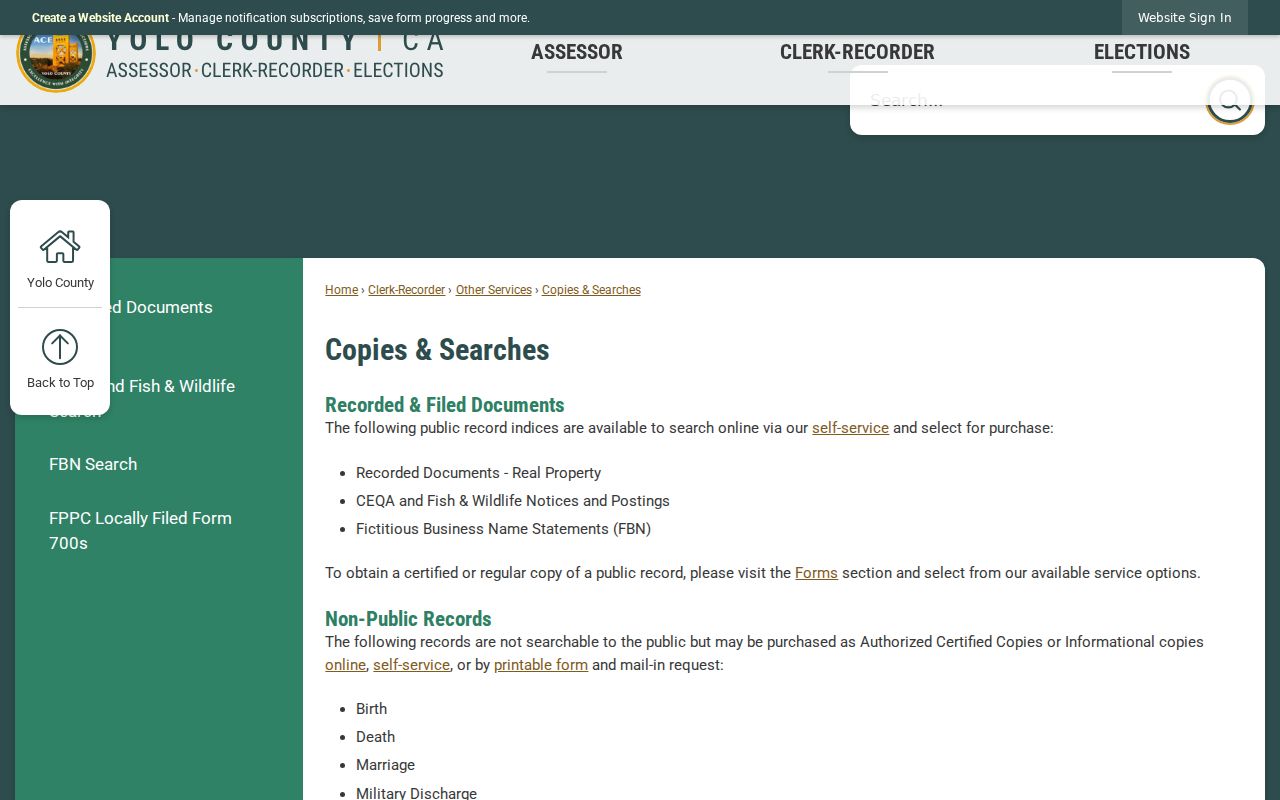
Do not pay a private solicitation without checking the official office. The county’s own index, kiosk, counter, and order process are the primary record path.
Walk Back the Woodland Deed Chain
To trace previous residents of a Woodland address, begin with today’s parcel rather than a free-form name search. At the Yolo Assessor counter or public computer, capture the current assessee, mailing address, APN or location designation, latest recorded document, exemption, values, and any map reference. Telephone service at 530-666-8135 can cover up to three parcels. The mailing address is a clue about where tax correspondence goes, not proof of occupancy.
Open the latest instrument in the Yolo Official Records Search. Match the legal description or APN, record the grantor and grantee, date, document type, and instrument number, then search the seller as an earlier grantee. Images are viewed at the Clerk-Recorder kiosk or ordered through its copy process. The web page does not state an index start year, so do not turn the office’s 1850 record coverage into an assumed online cutoff.
- Resolve the current street address to APN, legal description, lot, block, and subdivision in the Assessor or GIS.
- Find the latest acquisition instrument and identify the grantee and grantor roles.
- Search the prior seller as grantee before the sale date, matching the same legal description or parcel.
- Repeat backward, recording trusts, spouses, entities, liens, reconveyances, and parcel changes separately.
- Use the kiosk, counter, mail request, deed books, historic rolls, and Archives when the online index is not enough.
- Grantor / grantee
- The grantor transfers or releases an interest; the grantee receives or claims that interest.
- Chain of title
- The linked sequence of recorded transfers and related instruments for a parcel.
- Legal description
- The lot, block, subdivision, or other land description that can preserve parcel identity when a street address changes.
A deed grantee is not automatically a former occupant. Pair the ownership chain with directories, census, obituaries, and other household evidence.
Woodland Address Continuity
Older Woodland addresses do not always carry forward in the same typed form. City expansion east or southeast, rural-route conversion, subdivision plats, street extensions, and parcel splits can change the way a place appears in a directory or deed index. The research did not verify a single citywide renumbering year, so do not invent one. Preserve the old printed address, new address, APN, lot and block, subdivision, and Sanborn sheet reference together.
Use the official city street list for current accepted names and ranges. Use GIS to check the municipal line and parcel geometry. Use the legal description for deeds. A same-name street in another ZIP or a new high-number subdivision can otherwise look like a missing prior household. When an address cannot be reconciled online, the Archives map books and historic rolls are the fallback.
Woodland Buildings Before Residents
Sanborn maps and permits help place a household in the structure that existed at the time. Yolo Archives holds Woodland Sanborn material from 1926–1961, and selected sheets appear through the Library of Congress. A map can show footprint, street number, materials, use, and nearby lots. Woodland permit inquiry can add project date, type, parcel, and named applicant or contractor where the selected record exposes them. Neither source proves who lived there.
Compare the directory address with the Sanborn sheet and permit chronology, then test the lot against the deed and assessment record. A reroof, addition, demolition, or new subdivision can explain why a later city directory entry does not line up with an earlier one. Plans and code-enforcement files may have copyright, security, investigative, or personal-data limits.
The Archives is the stronger route for historic maps and tax material; the City is the route for its current permit inquiry. Treat each as a building-history layer in the previous residents workflow.
Woodland Court Endpoints
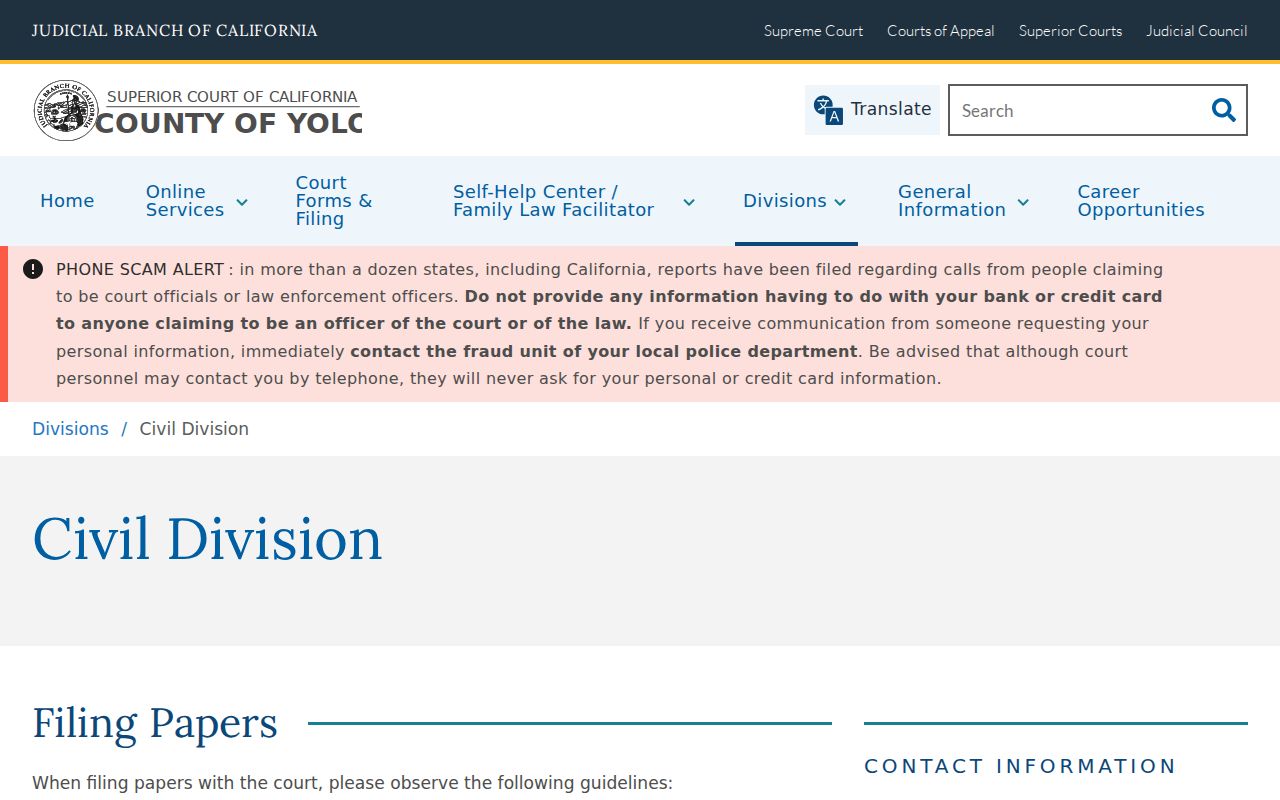
When a former household member died, moved through probate, or appeared in a local civil matter, Yolo Superior Court can provide a dated endpoint. The civil division keeps public files at the clerk and accepts written copy requests with a case number, parties, document request, payment cap, and self-addressed stamped envelope. The civil line is 530-406-6704. Contact the court before requesting cases older than ten years; offsite files can take up to two weeks.
The civil-division source is linked before its screenshot. It shows the public counter and mail-copy channel that a house-history researcher uses when a portal summary is not enough.
Review Yolo Civil Division access
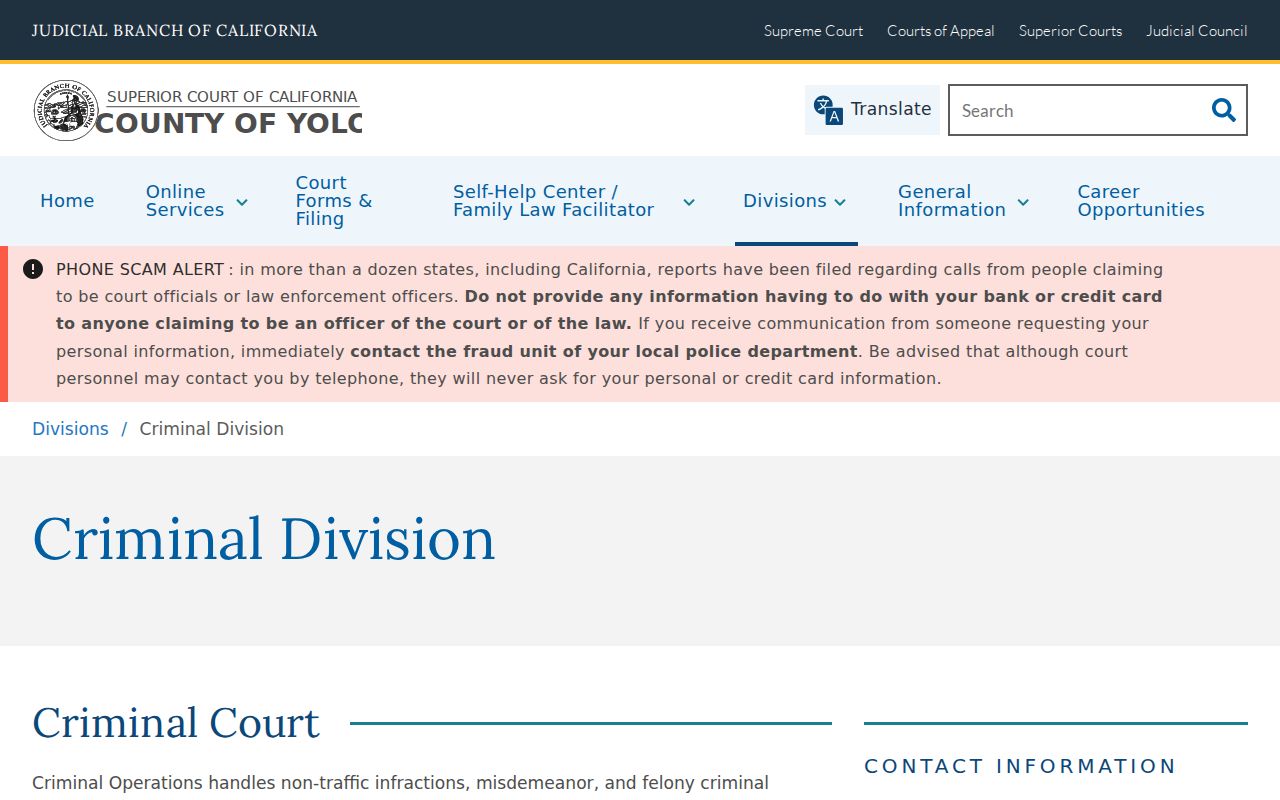
Criminal records have their own access and confidentiality limits. The Yolo Criminal Division lists $0.50 per page for copies, $40 per certified packet, and $15 for written searches that require identifiers such as full name, date of birth, violation or arrest year, and phone. Police and probation reports can remain closed.
See Yolo Criminal Division rules
A court endpoint can explain a date or relationship, but a case party is not automatically the person who occupied a house. Match it with the address and household sources.
Woodland Obituary and Probate Clues
Obituaries, newspapers, and probate can close a previous-resident trail when a directory entry disappears. Yolo Archives holds Daily Democrat microfilm from 1878–1950 and The Mail of Woodland from 1890–1952, with later newspaper paths and on-site databases available subject to access. Search exact spelling, spouse pairs, street address, business, and likely date range. A notice may establish a move, death, wedding, or family relationship without confirming the person’s last address.
Probate petitions and notices can identify a decedent, petitioner, proposed heirs, and a property connection. Addresses, inventories, and sealed or restricted portions may not be public. Use a public filing as a clue and ask the court or counsel for the lawful copy route. For cemetery or funeral-home evidence, corroborate with a certificate, obituary, or probate record when identity matters.
Woodland Households Across Time
Previous residents of a Woodland address are often easier to see in the household layer than in the deed chain. Use the Polk alphabetical section for a name, then the street or criss-cross section for an address when that volume includes it. Pair the nearest directory with the 1940 or 1950 census. A directory may list one adult, spouse, occupation, and address; a census may show a fuller household. Neither source is complete for every year.
The Yolo Archives collection page covers the research room, while the Woodland city directory collections explain the year runs and entry fields. Obituaries can establish a death or family link. Probate petitions may identify heirs. Cemetery and funeral-home records are clues that should be corroborated with a certificate or probate file. A person disappearing from a directory may have moved, died, been omitted, or fallen into a publication gap.
Lawful use. Woodland past-resident research is for house history, family history, lawful reconnection, and personal curiosity. Do not use a living person’s record to stalk, harass, threaten, or track them; California Penal Code §646.9 and §653.2 can apply.